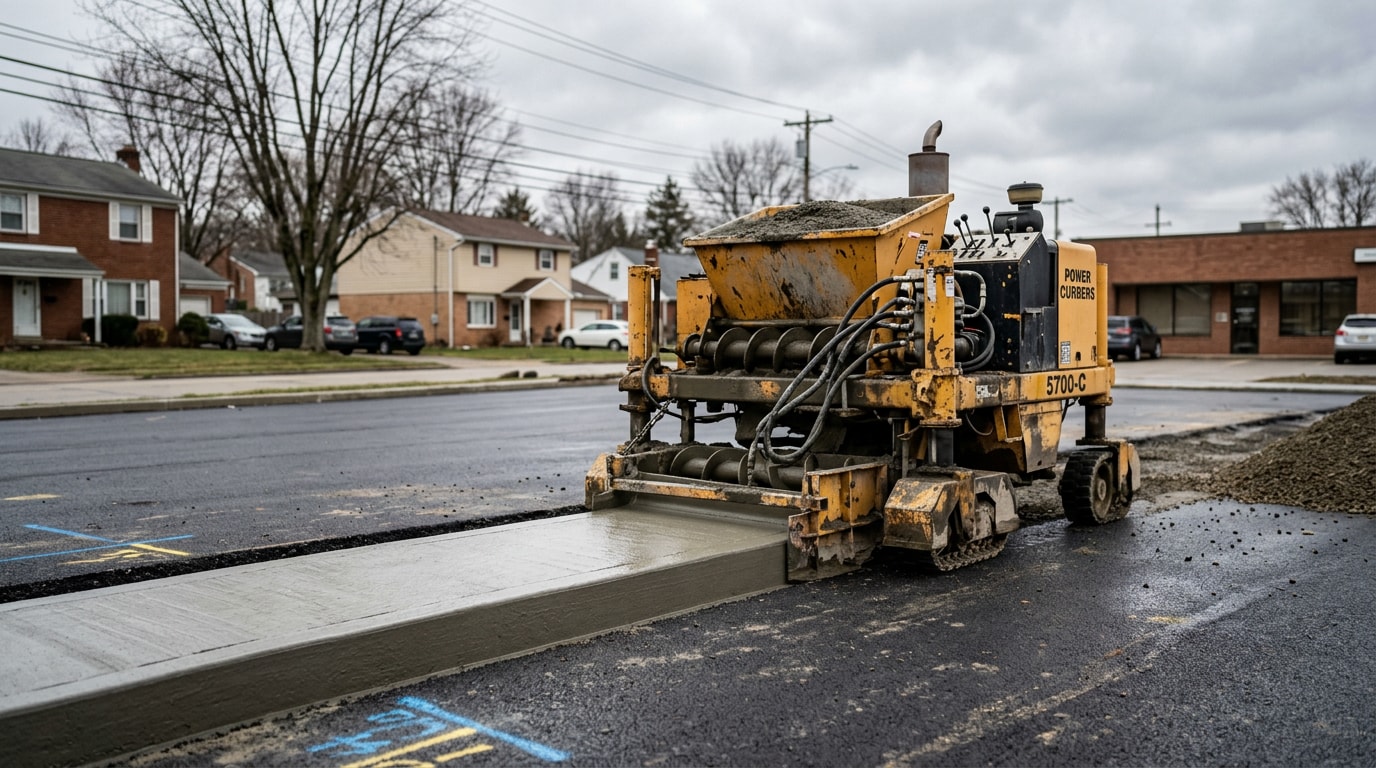
A concrete curb machine in Cheswick, PA extrudes continuous concrete curb in one pass instead of hand-building wood forms, which is why contractors and landscaping crews across Allegheny County have largely switched to it. Property owners usually land on this topic while pricing a DIY curbing project or sanity-checking a contractor's bid. The machine itself is only half the story, though. The other half is whether the operator understands Western PA's freeze-thaw cycles and clay soil, because that's what actually determines whether a curb lasts 20 years or cracks apart by its second winter.
What Is a Concrete Curb Machine?
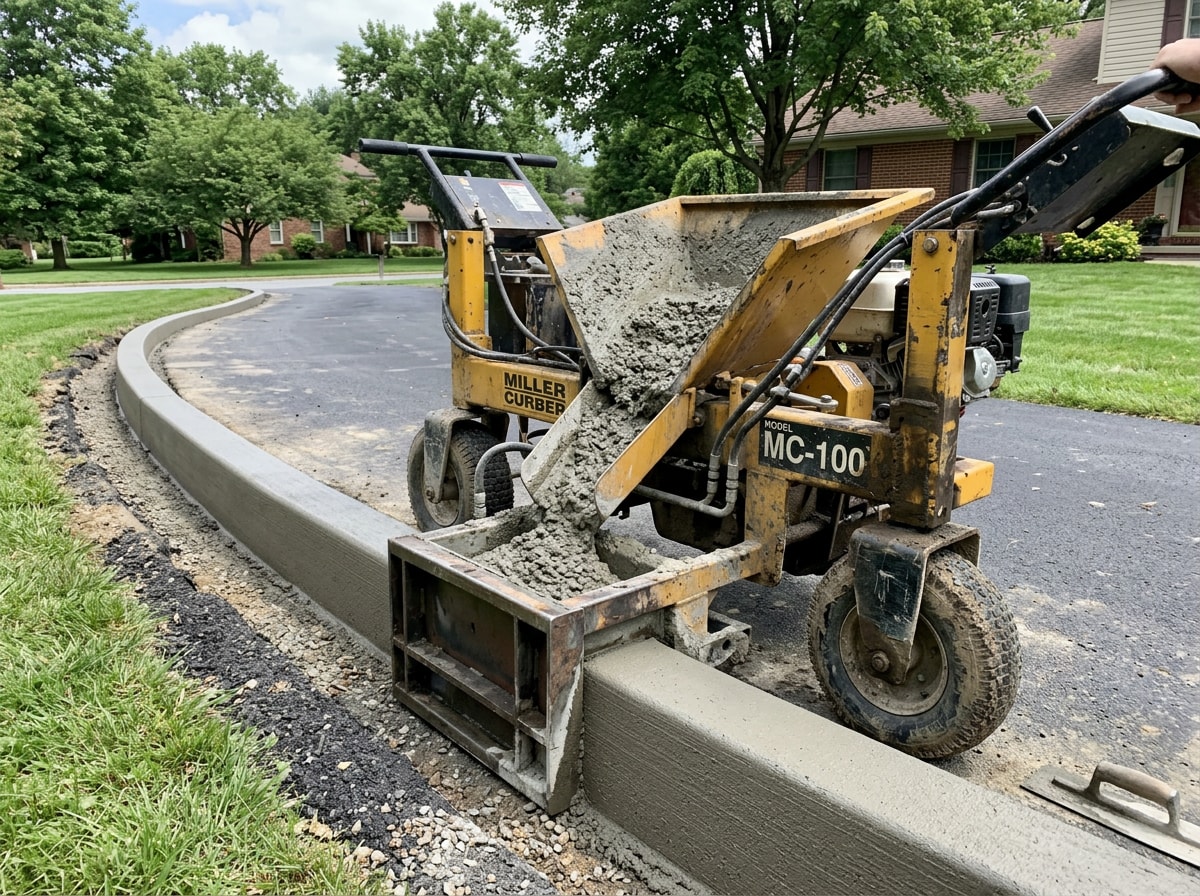
A concrete curb machine, also called a curb extruder or landscape curbing machine, is equipment that produces continuous concrete curb without the manual labor of building wood forms. It pumps a stiff, no-slump concrete mix through a shaped mold as the machine travels along a path, leaving a finished curb behind in one continuous pour.
For property owners near Cheswick, this has become the standard way to install durable curbing faster and more consistently than hand-forming. Whether the job is a quarter-mile parking lot or a short residential walkway, the same principle applies: steady material feed, a precise mold, and continuous forward motion.
Purpose and Common Applications
Concrete curbs do more than mark the edge of a driveway. They act as safety barriers that separate traffic lanes from parking spaces, and they channel surface runoff toward storm drains instead of letting it pool or erode soil. In developed areas, impervious surfaces such as pavement and roofs prevent precipitation from naturally soaking into the ground, so water runs rapidly into storm drains, sewer systems and drainage ditches, which can cause downstream flooding and erosion. Properly placed curb and gutter is part of how that runoff gets controlled rather than left to find its own path.
Around Cheswick, curb applications show up everywhere: a homeowner edging a driveway, an HOA defining a landscape border at a neighborhood entrance, or a commercial property owner marking out parking lot curb lines and islands. Our crews at Johnny's Asphalt have poured and repaired curb lines throughout Cheswick, Hampton Township, and the rest of Allegheny County, and the jobs that fail early almost always skipped proper base prep, not a machine malfunction.
How Much Does a Concrete Curb Machine Cost?
Curbing machine price depends heavily on size, automation, and whether you're buying consumer-grade landscape equipment or heavy municipal slipform gear. New landscape curb machines (walk-behind, ride-on, trailer-mounted) typically run $10,000 to $55,000 depending on features and output. Used models often sell for $5,000 to $25,000.
That price range is for decorative landscape and light-commercial curbing equipment. It's a different category from the large slipform curb-and-gutter machines municipalities and highway contractors use for continuous roadway curb, which can cost many times more. Power Curbers has built commercial concrete curb and sidewalk machines engineered for precision, durability, and high-production paving since 1953 , and that class of equipment is priced for daily production runs measured in miles, not driveways.
Factors That Affect Cost
Machine type is the biggest price factor:
- Ride-on units generally run $40,000–$55,000
- Walk-behind machines fall between $15,000–$30,000
- Trailer-mounted (tow-behind) models land around $10,000–$20,000
Added features push prices higher too. Automatic controls, adjustable-width molds, vibration dampening, and GPS-guided alignment can add roughly 15–20% to the base price.
These figures should be checked against current market conditions before budgeting a purchase, since material costs shift. Ready-mix concrete prices were down 0.4% over the month and have only risen 2.2% from a year ago as of mid-2026, which is a reminder that concrete input costs move independently of equipment prices and can swing a job's total cost more than the machine choice does.
Typical Price Ranges for Finished Curbing
Purchasing a machine is a different question than what installed curbing costs. For homeowners comparing a DIY purchase against hiring it out, installed concrete curbing (labor and material together) typically lands somewhere between $4 and $20 per linear foot, with plain gray curb on an easy-access site at the low end and stamped or colored decorative curb on a tight residential job at the high end.
Maintenance on an owned machine also adds up. Belts, augers, hydraulic fluid, and mold wear can add an estimated $1,000 a year to total cost of ownership, more for machines run daily. Factoring in upkeep alongside the sticker price gives a more honest comparison between buying outright, renting for a single project, or hiring a crew that already owns the equipment through our Concrete Finishing service.
Types of Concrete Curb Machines
Not every curb job calls for the same equipment. The main types fall into three categories:
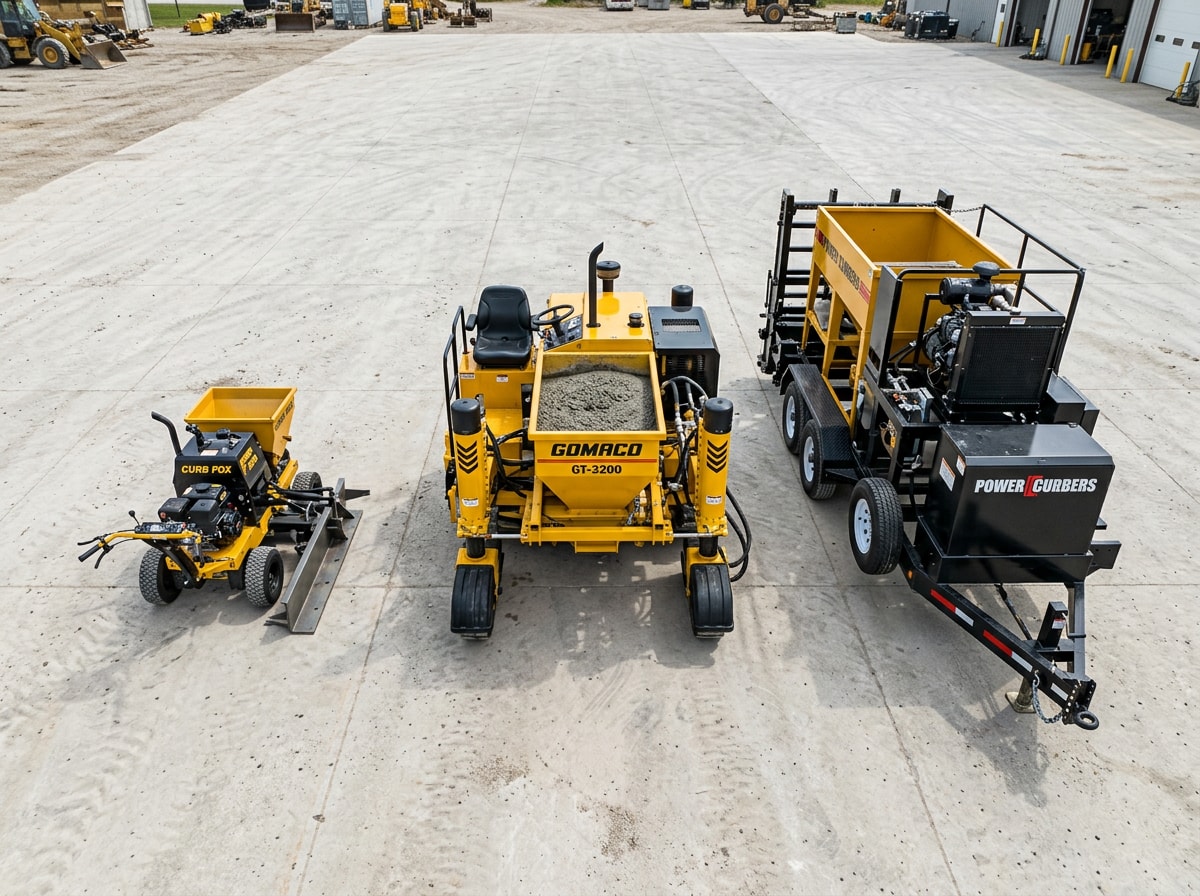
- Walk-behind curb machines — best for tight residential spaces, sloped yards, and curvy landscape borders
- Ride-on curb machines — best for larger commercial runs where output and operator comfort matter
- Trailer-mounted curb machines — best for crews that need to haul easily between multiple job sites in a day
| Machine Type | Typical Cost Range | Best Project Size | Speed/Output |
|---|---|---|---|
| Walk-behind | $15,000–$30,000 | Residential, small commercial | 20–40 linear ft/min |
| Ride-on | $40,000–$55,000 | Large commercial, municipal | 40–75 linear ft/min |
| Trailer-mounted | $10,000–$20,000 | Mixed residential/light commercial | 25–45 linear ft/min |
Actual pricing and output vary by manufacturer, mold width, and mix design, so treat this as a planning range rather than a quote. Commercial vs. residential decisions usually come down to volume: a landscaping crew doing a handful of driveways a month rarely needs the horsepower of a ride-on machine, while a contractor running curb daily recoups the extra cost in output.
For larger commercial projects like parking lots and site islands, see our parking lot resurfacing services.
Key Features That Matter
Beyond the type of machine, a handful of features separate a smooth workday from a frustrating one.
Quality and Durability
Curb machines work in rough conditions: wet concrete, uneven ground, and back-to-back job sites. Heavy-duty construction and quality components hold tighter tolerances over time and need less downtime. Cheaper machines with lightweight frames or underpowered augers tend to wear out faster and produce less consistent curb profiles.
Efficiency and Speed
Anti-bridging technology keeps concrete flowing evenly through the hopper instead of clumping mid-pour, which keeps extrusion speed steady across long runs. For a contracting business, a consistent extrusion rate means fewer crew hours per linear foot and more completed jobs per week.
Precision in Curbing
A well-built machine produces a consistent curb shape from the first foot to the last, staying parallel to buildings, sidewalks, or lot lines. That consistency matters for function as much as curb appeal; uneven curb height can trap water or look sloppy next to a finished driveway.
Why Professional Installation Still Matters
Owning or renting a concrete curb machine doesn't automatically guarantee a good result. Controlling mix flow and set times, aligning the mold on slopes and curves, finishing edges without trowel marks, and placing joints correctly all take practice.
Western Pennsylvania adds another layer of difficulty. Cheswick and the surrounding Allegheny County communities see repeated freeze-thaw cycles each winter, and much of the local soil runs clay-heavy and holds water. That combination makes proper base prep and correctly spaced joints especially important.
As a reference point for the kind of spec a regional engineer would use near Pittsburgh, a University of Pittsburgh facilities standard for exterior concrete curb calls for 4,000 PSI concrete with 5% air entrainment for freeze-thaw resistance, expansion joints at roughly 50 feet on center, and control joints every 10 feet. All concrete shall be 4000 PSI at 28 days, with cement that is high early strength , which is noticeably stricter than the generic "any ready-mix will do" advice found in most national cost guides. Skip that level of detail and curbing can heave, crack, or separate from the base within a season or two.
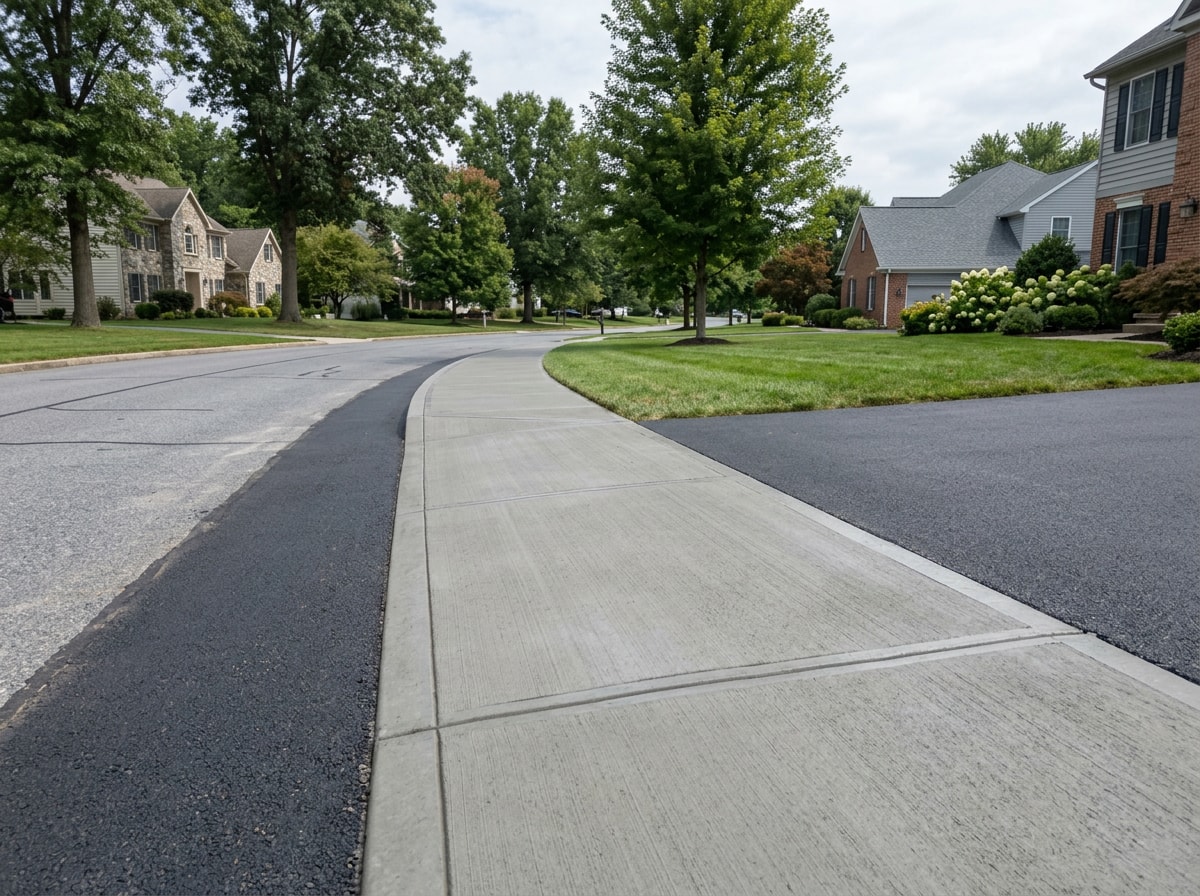
Good base prep starts before the first foot of curb goes down. See our site preparation page for how that work is scoped, and check our Cheswick, PA service area page to confirm coverage for your street. If you'd rather skip the equipment math entirely, get your free estimate and we'll walk the site with you first.
Property owners weighing concrete against other hardscape options in the same neighborhood may also find our guide to concrete patios in Cheswick, PA useful for comparing cost and build process on a related project.
FAQ
How does a concrete curb machine work?
A concrete curb machine feeds stiff, low-slump concrete into a hopper, where an auger or piston pushes it through a shaped mold as the machine rolls forward. The result is continuous extrusion with a consistent profile, rather than the hand-formed sections required with traditional wood-form methods.
How much does concrete curbing cost per linear foot?
Installed concrete curbing typically costs $4 to $20 per linear foot, depending on region, curb size, and whether decorative color or stamping is added. Plain gray curb on a large, easy-access job sits at the low end; curved or decorative work on a small residential job pushes costs toward the higher end.
How long does concrete curbing last?
Well-installed concrete curbing typically lasts 20 to 30 years, sometimes longer with proper sealing and maintenance. In Pennsylvania, freeze-thaw cycles can shorten that lifespan if the base wasn't compacted correctly or joints weren't spaced to allow for expansion, so installation quality matters as much as the concrete mix itself.
Can you rent a concrete curb machine instead of buying one?
Yes. Many equipment rental yards and curb machine dealers offer daily or weekly rentals, which usually makes more financial sense than buying if you only have one or two projects planned. Factor in that rentals still require an experienced operator to get a clean result; the machine doesn't run itself.
How much curb can a crew install in a day?
A typical walk-behind or trailer-mounted machine can extrude 20 to 45 linear feet per minute, but real-world daily output depends on site access, curves, and cure-time management. Most residential crews finish 150 to 400 linear feet per day; commercial crews with ride-on machines can cover significantly more on open, straight runs.
Is concrete curbing worth it?
For most property owners, yes. Concrete curbing costs more upfront than plastic or metal edging but lasts decades longer with minimal upkeep, which usually makes it the better choice for anyone planning to stay on the property long-term. Request a quote to compare costs for your specific project.