Concrete density in Hampton Township, PA determines how much a poured slab, footing, or patio actually weighs per cubic foot, and that number drives strength, load calculations, and cost. Most residential pours in this part of Allegheny County land close to 150 lb/ft³ (2,400 kg/m³), but the exact figure shifts with aggregate, water content, and how the crew finishes the job. Here's how density is measured, what changes it, and why Hampton Township's frost line and freeze-thaw winters make it worth getting right the first time.
What Is Concrete Density?
Concrete density is the mass of concrete per unit of volume — how much a specific amount of concrete weighs. It's expressed in kilograms per cubic meter (kg/m³) or pounds per cubic foot (lb/ft³), and it varies with mix design, aggregate, and how the concrete is placed.
The commonly cited baseline for normal-weight concrete is about 2,400 kg/m³, or roughly 150 lb/ft³. That figure is a reference point, not a fixed constant — actual density moves with every mix.
Since Pennsylvania suppliers and contractors typically work in pounds and cubic feet, here's a quick conversion reference:
| Concrete Type | kg/m³ | lb/ft³ |
|---|---|---|
| Lightweight | 1,400–1,800 | 87–112 |
| Normal-weight | 2,200–2,500 | 137–156 |
| High-density | 2,800–6,400 | 175–400 |
How to Calculate the Density of Concrete
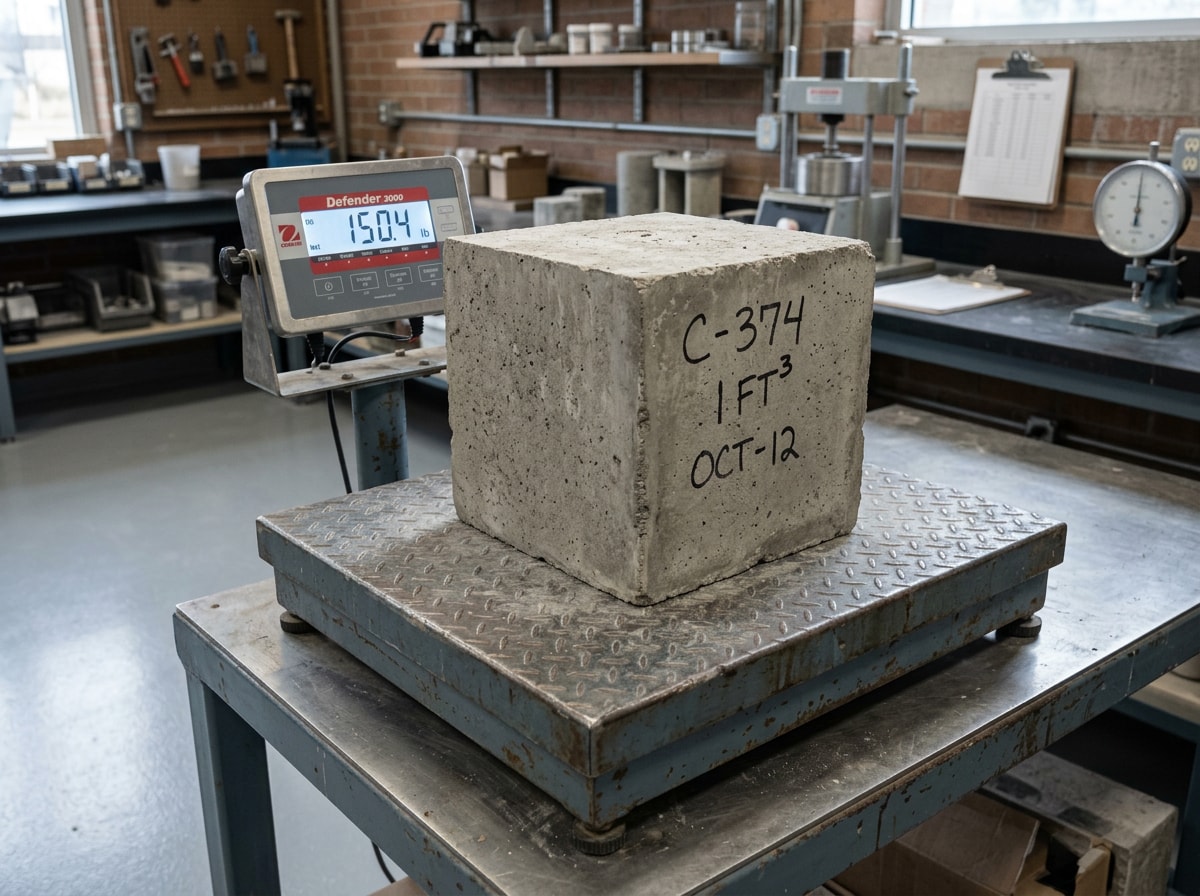
To calculate concrete density, use the formula: Density = Mass ÷ Volume. Cast a sample into a container of known volume, weigh it, then divide mass by volume.
Worked example: a cylinder with a volume of 1 cubic foot weighs 148 pounds. Divide 148 lb by 1 ft³ and you get 148 lb/ft³ — right in the normal-weight range.
Whether you weigh concrete wet (freshly mixed) or dry affects the reading, since fresh concrete still holds mix water that evaporates during curing. For a standardized field method, crews use ASTM C138, the test standard that covers density, yield, and air content of freshly mixed concrete.
On local pours across Hampton Township and the North Hills, our finishing crews check slump and density before a truck leaves the site. An over-wet load is the single most common reason a driveway or patio comes up short on strength the following spring.
What Affects Density On-Site
Density isn't fixed — it shifts based on the materials used and how the concrete is handled during placement. Two factors matter most: the mix itself and the way it's compacted and cured.
Aggregate Type and Proportion
Aggregate choice has the biggest influence on density. Crushed stone and gravel raise the final number, while lightweight aggregate — expanded shale, clay, or pumice — lowers it. More aggregate by volume generally means a denser mix, assuming the aggregate is heavier than the surrounding cement paste.
Water-Cement Ratio, Compaction and Curing
Excess water lowers both density and strength by creating extra pore space once it evaporates. Proper compaction — vibrating the concrete to remove trapped air — raises density and improves the hardened value. Curing conditions matter too: concrete kept consistently moist typically reaches higher strength and density than concrete left to dry out too fast.
Density also has to share the mix design with air content, especially here. Most PennDOT-spec projects require entrained air between roughly 3.5% and 5.0% for durability, and general exterior flatwork exposed to freeze-thaw cycles is often specified closer to 5% to 8%. Entrained air lowers density slightly but protects the slab from the freeze-thaw cycles that are routine in a Pittsburgh-area winter — a tradeoff a generic density chart won't tell you about.
Typical Density Ranges by Concrete Type
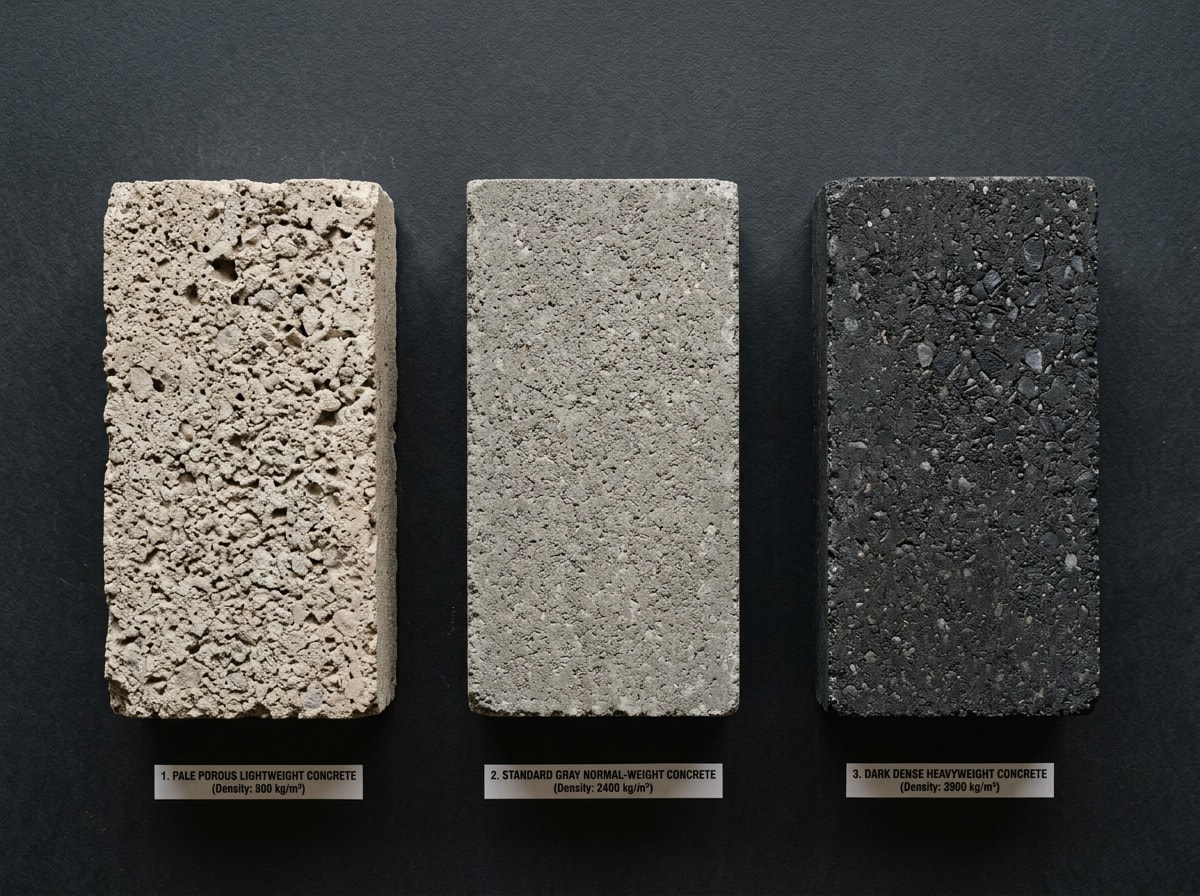
Concrete isn't one fixed number — density varies by category and intended use. The table above covers the basics; here's what each range actually means on a job site.
Normal-Weight Concrete
Normal-weight concrete typically falls between 2,200–2,500 kg/m³ (137–156 lb/ft³). This range covers most residential and commercial work, including reinforced concrete, since steel reinforcement barely changes the bulk density of the finished product.
Lightweight Concrete
Lightweight concrete runs lower, generally 1,400–1,800 kg/m³ (87–112 lb/ft³), and is used where reduced structural load or better insulation matters. For structural lightweight concrete specifically, ACI's structural lightweight concrete guide (ACI 213R) sets a density ceiling around 1,840 kg/m³ (115 lb/ft³).
High-Density (Heavyweight) Concrete
High-density, or heavyweight, concrete uses heavy aggregates like barite or magnetite to push density well above normal-weight ranges, sometimes exceeding 6,400 kg/m³ (400 lb/ft³). It's mainly used for radiation shielding and counterweight or ballast applications, not general residential construction.
Why Density Matters for Hampton Township's Climate and Codes
Denser concrete generally has fewer internal voids, which means higher compressive strength and better resistance to water and chemical penetration — important for durability through Western Pennsylvania winters. Density also affects the load-bearing weight a structure must account for, which matters for foundation and framing design.
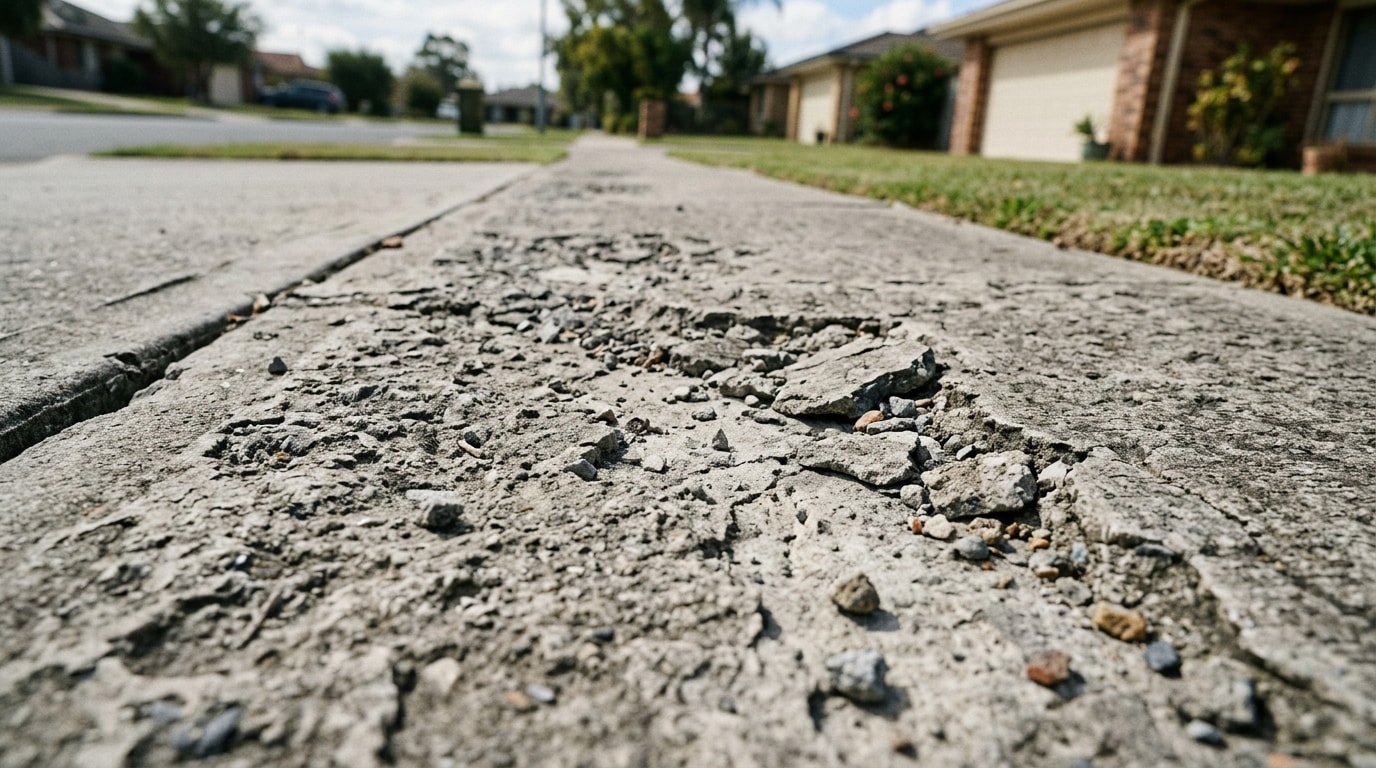
Pennsylvania's building code also ties into this indirectly through frost depth. Footings across most of the state, including Allegheny County, generally need to reach around 36 inches below grade, though local amendments can run anywhere from 30 to 42 inches depending on the municipality. A footing poured with the wrong density, air content, or depth is a common cause of the heaving and cracking we get called out to repair every spring.
Higher density doesn't automatically guarantee higher strength, though. A poorly proportioned mix can still be dense but weak if the cement paste quality is low or curing was inadequate. Density is a useful indicator, not a standalone guarantee of performance.
If you want a mix confirmed for Hampton Township's frost line, air content specs, and your project's load, get your free estimate before the next pour. Our crews also handle related prep work through site preparation and concrete finishing for driveways, patios, and footings across the area. If a slab is already showing damage, our guide to a cracked concrete patio in Hampton Township walks through causes, repair options, and costs.
FAQ
What is the standard density of concrete?
The standard density of concrete is approximately 2,400 kg/m³, or about 150 lb/ft³. This applies to normal-weight mixes used in most residential and commercial construction.
Does concrete density affect its strength?
Generally, yes — denser concrete tends to have fewer voids and higher compressive strength. Mix quality and curing also play a major role, so density alone doesn't determine strength.
What is the dry density of concrete versus wet density?
Wet (fresh) density includes mix water that hasn't evaporated yet, so it reads higher than dry, hardened density. A sample that tests at 150 lb/ft³ fresh will typically settle a bit lower once fully cured and dried.
What is the density of RCC (reinforced cement concrete)?
Reinforced cement concrete typically ranges from 2,400–2,500 kg/m³. The slight increase over plain concrete comes from the embedded steel reinforcement.
What is the density of RMC (ready-mix concrete)?
Ready-mix concrete density usually falls within the normal-weight range, though the exact figure depends on the mix design ordered from the supplier. The National Ready Mixed Concrete Association notes that if lightweight or heavyweight concrete is needed, the target density has to be stated at the time of order.
Does Hampton Township's climate change what density I need?
Not the base density itself, but it changes what's specified alongside it. Freeze-thaw cycles typically call for air-entrained mixes, which slightly lower density but add durability — something worth discussing with your contractor before the pour.
Ready to plan a pour that accounts for local frost depth and freeze-thaw exposure? Get your free estimate or visit our homepage to see our full range of concrete and paving work in Hampton Township.